

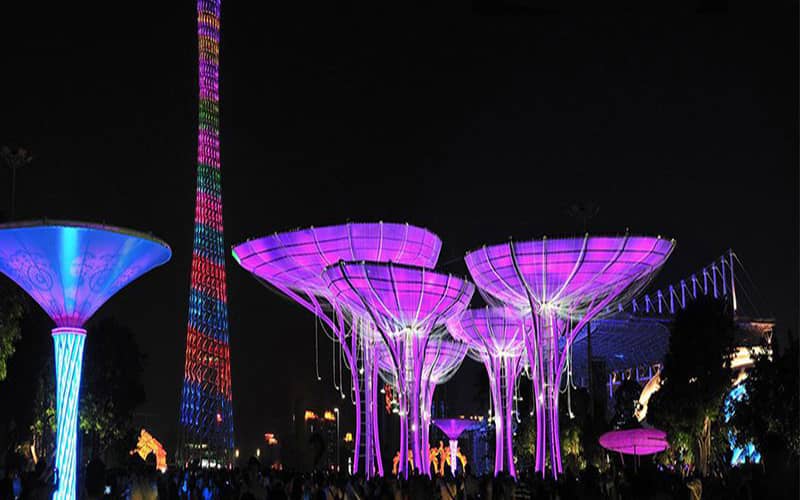
In high-performance architectural, industrial, and filtration applications, material stability under fluctuating temperatures is a critical engineering requirement. One of the most common long-term risks in polymer-based membranes is creep deformation, particularly in environments characterized by continuous temperature swings. The PTFE membrane structure has proven to be one of the most reliable solutions to this challenge, offering exceptional dimensional stability, low creep rates, and long service life.
Texmond, as a professional supplier among global PTFE membrane structure manufacturers, has developed advanced PTFE membrane architecture designed specifically to address creep deformation in temperature-variant environments. This article explores the structural mechanisms behind PTFE membranes and explains why they outperform conventional membrane materials under thermal stress.
Understanding Creep Deformation in Temperature-Swing Environments
Creep deformation refers to the gradual, time-dependent deformation of a material when subjected to constant stress. In membrane systems, creep is significantly accelerated by:
-
Repeated thermal expansion and contraction
-
Long-term tensile loading
-
UV exposure combined with temperature cycling
-
Molecular chain mobility in polymer materials
In environments where temperatures fluctuate between extreme highs and lows—such as outdoor tensile structures, industrial enclosures, and filtration systems—traditional membrane materials often experience irreversible elongation, loss of tension, and structural instability.
This is where PTFE membrane architecture offers a decisive advantage.

How PTFE Membrane Structure Controls Molecular-Level Deformation
The superior creep resistance of PTFE membranes begins at the molecular level. PTFE (polytetrafluoroethylene) features a highly stable carbon–fluorine bond, which significantly limits molecular chain movement even under thermal stress.
Key structural characteristics include:
-
High crystallinity, reducing chain slippage under load
-
Low coefficient of thermal expansion, minimizing dimensional change
-
Chemical inertness, preventing degradation during long-term exposure
Texmond optimizes these properties through controlled material formulation and precision processing, ensuring the PTFE membrane structure maintains stability across wide temperature ranges.
The Role of PTFE Membrane Architecture in Creep Reduction
While material composition is essential, structural design plays an equally critical role. A well-engineered PTFE membrane architecture distributes stress evenly across the surface, reducing localized strain that typically accelerates creep.
Structural Design Factors That Reduce Creep:
-
Multi-layer membrane construction to balance tensile loads
-
Uniform fiber orientation to prevent directional elongation
-
Optimized coating thickness to stabilize the surface under heat cycling
Texmond’s PTFE membranes are designed with a reinforced architectural framework that maintains tension integrity even after years of thermal cycling.

Performance Under Temperature-Swing Conditions
In real-world applications, PTFE membranes are often exposed to daily and seasonal temperature variations ranging from extreme cold to intense heat. Poorly designed membranes may relax, sag, or permanently deform over time.
Texmond’s PTFE membrane structure is engineered to withstand:
-
Rapid temperature transitions without stress concentration
-
Continuous thermal expansion and contraction cycles
-
Long-term tensile loading in outdoor environments
This makes Texmond membranes suitable for applications such as tensile architecture, industrial roofing, chemical processing facilities, and advanced filtration systems.

PTFE Membrane Structure vs Conventional Materials
Compared to PVC or ETFE-based membranes, PTFE membranes demonstrate significantly lower creep deformation rates.
| Material Type | Creep Resistance | Thermal Stability | Long-Term Structural Integrity |
|---|---|---|---|
| PVC Membrane | Low | Moderate | Limited |
| ETFE Film | Moderate | Good | Medium |
| PTFE Membrane Structure | High | Excellent | Long-Term Stable |
This performance advantage is why experienced engineers and project developers increasingly specify PTFE membranes for critical, long-lifespan installations.
Manufacturing Precision Matters
Not all PTFE membranes perform equally. The creep resistance of the final product depends heavily on manufacturing standards and quality control.
As one of the experienced PTFE membrane structure manufacturers, Texmond focuses on:
-
Controlled sintering and stretching processes
-
Precision fiber alignment and membrane tension calibration
-
Consistent coating and lamination quality
-
Strict thermal cycling and creep testing protocols
These manufacturing controls ensure that each PTFE membrane maintains predictable mechanical behavior throughout its service life.
Applications Requiring High Creep Resistance
Texmond’s PTFE membrane structure is widely used in applications where temperature variation and structural stability are critical:
-
Tensile membrane roofs and façades
-
Industrial filtration and separation systems
-
Outdoor enclosures and protective structures
-
Chemical and energy-sector installations
In these environments, long-term resistance to creep deformation directly impacts safety, aesthetics, and maintenance costs.
Why Texmond PTFE Membrane Structures Deliver Long-Term Value
Reducing creep deformation is not just a material advantage—it is a lifecycle cost advantage. Membranes that maintain their geometry and tension over time require less maintenance, fewer replacements, and lower total ownership costs.
Texmond’s approach combines advanced PTFE membrane architecture, rigorous manufacturing standards, and application-driven design to deliver membranes that perform reliably in temperature-swing environments for decades.
Conclusion:
Creep deformation is one of the most critical challenges for membrane materials operating under fluctuating temperatures. Through its inherently stable molecular structure and carefully engineered architectural design, the PTFE membrane structure offers unmatched resistance to long-term deformation.
As a trusted name among PTFE membrane structure manufacturers, Texmond continues to advance membrane performance by combining material science expertise with precision manufacturing. For projects requiring durability, dimensional stability, and long-term reliability under thermal stress, PTFE membranes remain the proven solution.